Table Of Content
Formal Life Cycle Cost Analysis (LCCA) according to the Life Cycle Cost Analysis Procedures Manual is not required for minor pavement rehabilitation (CAPM) projects. However, some cost analysis is required to support effective pavement management decisions, such as analyzing the cost effectiveness of minor (CAPM) versus major pavement rehabilitation (2R or 3R). A comparison of different pavement products or strategies should be done to support project scoping and life cycle planning during the preparation of the PIR.
Propose a Revision to the HDM
On January 28, 2022 Caltrans released a memorandum discussing the traffic calming techniques that exist in Caltrans guidance that can be used with the intent to slow speeding vehicles. On February 24, 2022 Caltrans unveiled a new Director’s Policy on Road Safety which commits the department to the Safe System approach and reaffirms the vision of reaching zero fatalities and serious injuries on state highways by 2050. Caltrans is the California Department of Transportation and is responsible for providing a safe, sustainable, efficient and integrated transportation system that meets the needs of all roadway users in California. The new bill is similar to an earlier one that Senator Wiener got past the legislature a few years ago - despite resistance from Caltrans - only to have it vetoed by Governor Newsom. At the time, Newsom said the bill was "not necessary" because Caltrans was already in the process of adopting its own internal guidelines for Complete Streets. In February, 2022 the Caltrans Office of Race & Equity released an update to the 2019 Race and Equity Action Plan (REAP), which is a living document that aligns with Caltrans Strategic Plan Goals.
Proving to Caltrans That El Camino Real Can Be a Safer Street - Streetsblog San Francisco - Streetsblog San Francisco
Proving to Caltrans That El Camino Real Can Be a Safer Street - Streetsblog San Francisco.
Posted: Thu, 17 Oct 2013 07:00:00 GMT [source]
Streetsblog California
Unique situations may call for variation from the policies and procedures described in this document, subject to Division of Design or delegated approval, or such other approval as may be specifically provided for in the text. It is difficult enough for Caltrans headquarters to come to agreement on what should be included and prioritized in a complete streets policy. It's another step to get the twelve districts around the state to take them seriously. Caltrans districts shouldn't be able to claim credit for fulfilling only the most basic and simple of what are listed as "complete streets" elements. Even the best policy on the books - even this new high-quality Design Information Bulletin - can't force them.
Department Links
Minor pavement rehabilitation (CAPM) is a planned pavement management strategy to make cost-effective repairs on existing roadways in generally fair condition with considerable remaining service life (15 – 30 years). Minor pavement rehabilitation (CAPM) strategies are non-engineered pavement structure designs typically applied to moderately extensive existing structural distress that do not alter existing roadway geometric features. The goal of minor pavement rehabilitation (CAPM) is to extend pavement service life about 5 – 10 years, before costlier major pavement rehabilitation (2R or 3R) is required.
Thus, a performance-based approach is utilized based on performance objectives and assets. This approach together with Departmental goals should result in pavement projects with added features that are feasible, practical, and cost-effective. The work included in a minor pavement rehabilitation (CAPM) anchor project should not propose major facility upgrades but should include all appropriate items of work as discussed in this DIB and within the funding constraints.
0 Process
No matter which of the formats is used to download and/or print, if the HDM Holder chooses to do so, the Holder is responsible for keeping their electronic and/or paper copy up to date and current. For this reason, HDM Holders are encouraged to use the on-line version of the HDM for the most current design guidance. See Chapter 100, Topic 105 for design guidelines of pedestrian facilities, including accessibility requirements, guidelines for curb ramps, and pedestrian crossings. One of Caltrans' primary goals is to promote health through safe active transportation and reduced air pollution.
An Evaluation of Ramp Control Signal Head Placement Based on Motorist's Cone of Visions - ScienceDirect.com
An Evaluation of Ramp Control Signal Head Placement Based on Motorist's Cone of Visions.
Posted: Mon, 04 Dec 2017 13:14:06 GMT [source]

Projects with combined extensive satellite asset work greater than half the estimated project cost may not be suitable pavement anchor projects. When minor pavement rehabilitation (CAPM) satellite work is part of another project anchor, limitation of other assets or features described in this DIB are not applicable. See DIB 79 Section 1.4 for information on the appropriate guidance to follow when there are minor and major pavement rehabilitation strategies within the same project limits. Minor pavement rehabilitation (CAPM) projects that are consistent with the guidelines in this DIB do not require design standard decision documentation for existing nonstandard geometric features unless the project scope degrades those features or creates new deviations. The bold and underlined pavement engineering design standards in HDM Chapters 600 through 670 still apply to minor pavement rehabilitation (CAPM) projects.
0 Minor Pavement Rehabilitation Strategies
The individual files in the HDM Table of Contents above are the official accessible version of the Highway Design Manual.
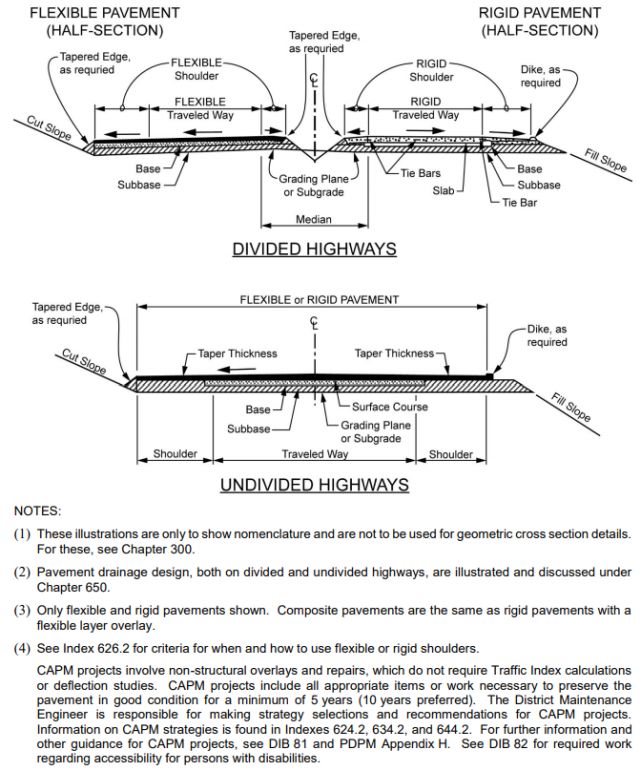
The Project Development Team guides project development decisions made on this issue. Minor pavement rehabilitation (CAPM) projects may also be appropriate and cost effective on Class 3 roads (see SHSMP) where the facility is beyond the capacity of maintenance preservation strategies to repair. Coordination with the HQ Pavement Program Advisor, District Pavement Program Advisor, and Division of Design (DOD) Project Delivery Coordinator is required if no future major pavement rehabilitation (2R or 3R) upgrades are planned. Otherwise, the project will be considered major pavement rehabilitation (2R or 3R) and is subject to the guidance in DIB 79 and design standard decision documentation for nonstandard features.
Field reviews should be scheduled to encompass as many different project locations as possible. Any project not reviewed by the HQ Pavement Program Advisor is at risk of being disputed if scoping issues are identified. Provides the framework of policies and procedures for developing State highway improvement projects. Minor projects do not require a PIR and become part of the District’s annual Minor Program. Guidance for preparation of the PIR is located on the Office of Project Planning website's Project Initiation Report (PIR) Guidance page.
The 7th Edition Highway Design Manual (HDM) establishes uniform policies and procedures to carry out the state highway design functions of the California Department of Transportation. These updates are incorporated in this revision and is consistent with the current process for scoping SHOPP projects. Every Caltrans district has completed a complete streets plan, meaning they have identified places where safety improvements need to be made. It considers context, including place type (rural, suburban, urban, city center) and road use (speeds and traffic levels) in its recommendations about what type of complete streets elements to consider including.
All minor pavement rehabilitation (CAPM) candidate projects should have a Scoping Team Field Review after initial development of the draft PIR to refine the project scope and determine appropriate repair strategies depending on pavement needs, traffic operations, and design standards. Federal-aid funding provisions allow for projects to accomplish preventive maintenance activities of the pavement. This work provides cost effective treatments to an existing roadway system without increasing pavement structural capacity. Geometric enhancements are not included, and the work cannot degrade any existing safety or geometric aspects of the roadway facility. Projects that propose improvements beyond the DIB 81 guidance will be processed using DIB 79. Recommended enhancements will be incorporated in the project if the inclusion does not change the target construction season.
The District Pavement Managers/Program Advisors submit project candidates to the Headquarters (HQ) Pavement Engineer/Program Advisor to develop the 10-year SHOPP plan. The candidate list should be submitted as early as possible in the annual project development cycle, usually in late winter/early spring, to assure identification and refinement of the best candidate projects before the development of scoping documents. Provides technical guidance for the purpose of translating complex statewide policies into practical Complete Streets roadway element implementation. The guide is continuously updated to reflect changes in policy and design best practices.
Any documentation of design decisions will be in the same manner as defined in HDM Chapter 80. Caltrans recently published the Sixth Edition of its Highway Design Manual, effective March 7, 2014. The Manual serves as the gold standard of best practices in procedures, policy, standards, and guidance in highway design, and is utilized by public agencies in all highway projects that receive state funding. A Project Initiation Document (PID) is used to nominate a major SHOPP project for programming. Depending on the scope of satellite asset work, most minor pavement rehabilitation (CAPM) projects should be Categorically Exempt (CE) projects with little or no environmental impact and work within the existing right of way.